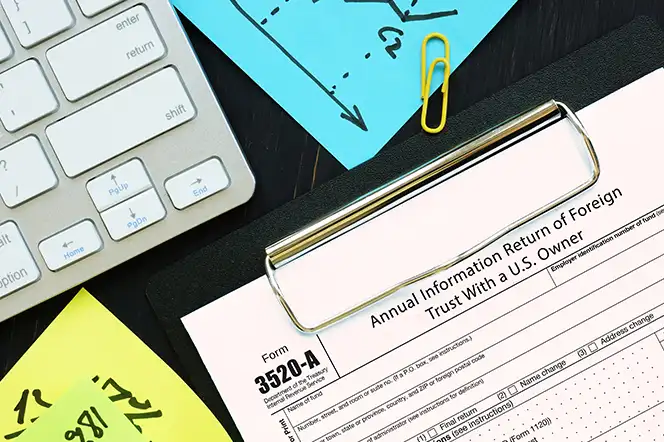
What is a Substituted 3520-A?
A substituted Form 3520-A is an alternative filing method available when a foreign trust fails to file a complete Form 3520-A. Instead of the trust filing the form, the US owner completes a substituted Form 3520-A and attaches it to Form 3520 by the applicable Form 3520 deadline.
Form 3520-A is generally due by the 15th day of the 3rd month after the end of the foreign trust’s tax year, with a possible six-month extension using Form 7004. A substituted Form 3520-A attached to a US owner’s Form 3520 is due by the Form 3520 deadline.
For US citizens abroad, Form 3520 is generally due with the individual income tax return, including applicable extensions. A complete substituted Form 3520-A attached to a timely filed Form 3520 may help avoid penalties for the foreign trust’s failure to file Form 3520-A.
Last updated June 16, 2026
Written by: Clark Stott
In this article
Note: Although many taxpayers refer to it as a “Substituted 3520-A,” the IRS instructions generally use the term “substitute Form 3520-A.” Both terms typically refer to the same filing prepared by the US owner when a foreign trust does not file a complete Form 3520-A.
What is Form 3520-A?
Form 3520-A is an information return used to report activities involving certain foreign trusts with US owners. Although the form itself does not generally create tax, failing to file it correctly can result in significant IRS penalties.
Form 3520-A collects information about the trust, its US beneficiaries, and any US person treated as an owner of any portion of the foreign trust. This is an essential document for US taxpayers who have transactions with or ownership of a foreign trust.
In simpler terms, if you are a US person treated as the owner of a foreign trust, Form 3520-A may be required. If you receive distributions from a foreign trust, Form 3520 may also be required.
Form 3520-A vs. Substituted Form 3520-A
A regular Form 3520-A is typically filed by the foreign trust, while a substituted Form 3520-A is prepared and filed by the US owner when the foreign trust fails to file a complete Form 3520-A.
Table 1. Form 3520-A vs substituted Form 3520-A
| Question | Form 3520-A | Substituted Form 3520-A |
| Who is responsible for filing? | The foreign trust | The US owner |
| What is the filing deadline? | March 15 (unless extended) | Same deadline as Form 3520 |
| Is a trust EIN required? | Yes | Yes |
| How is the form submitted? | Filed as a standalone return | Attached to Form 3520 |
How should US owners of foreign trusts manage their Form 3520-A obligations for UK pensions?
US owners of foreign trusts, such as UK pensions, will need to be diligent in their tax filings, specifically with Form 3520-A, to avoid costly penalties.
The form is due by March 15 each year, and if an extension is necessary, you can file Form 7004 by the same date.
Additionally, obtaining an Employer Identification Number (EIN) for the trust is a requirement for filing. However, if you’re having trouble meeting the original deadline, consider the option of a Substituted 3520-A. This permits a later filing alongside your 1040 form, extending the deadline significantly to April 15, with a possibility to October 15.
Due to the complexity and significant penalties for misfiling, it is highly recommended to engage a tax professional who specializes in Foreign Grantor Trust issues. These professionals can help ensure compliance and make use of your annual pension statements to properly prepare your tax forms.
Are UK pensions always treated as foreign trusts?
Not necessarily. UK pension treatment depends on the arrangement. Under our firm’s filing position, a UK SIPP is treated as triggering Forms 3520 and 3520-A. Other UK pension arrangements should be reviewed based on their specific structure and facts.
How do I get an EIN from the IRS for my UK pension?
Here’s how you can secure an Employer Identification Number (EIN) for your UK pension trust:
- Prepare your annual pension statement: This document is essential as it contains details about your pension scheme.
- Contact the IRS: Use their international phone line at +1 267 941 1099 and check the latest IRS opening hours before calling.
- Provide a unique name for your trust: For example, if your pension provider is Hargreaves Lansdown and your initials are SM, you might name it “HL SM Trust.”
- Undergo a verification process: Answer questions about your trust during the call.
- Register for an EIN: The IRS representative will guide you through the registration process and typically provide the EIN by the end of the call.
- Duration: The whole process usually takes about 30 minutes.
Can I fill out a Form 3520-A myself?
Filling out Form 3520-A on your own is a detailed process that requires careful attention to the IRS’s requirements for foreign trusts with a US owner.
We always recommend using a tax professional with extensive experience with Foreign Grantor Trusts, but if you’re going to have a go at it yourself, here’s a simple guide to get you started:
- Obtain the Form: Download the latest available Form 3520-A and instructions from the IRS website before preparing the filing.
- Gather Necessary Information: You’ll need detailed information about the trust, including the trust’s name, address, and the tax identification number. Additionally, compile financial information such as the trust’s income, distributions made during the year, and a complete inventory of the trust’s assets at the end of the tax year.
- Complete the Trustee’s Section: If the foreign trust does not file a complete Form 3520-A, the US owner should complete the substitute Form 3520-A to the best of their ability and attach it to Form 3520.
- Fill Out the Owner’s Information: As the US owner, provide your information in the designated sections. This includes your identification details and the nature of your ownership in the trust.
- Attach Required Statements: Form 3520-A requires certain statements to be attached, detailing the trust’s activities, distributions, and beneficiaries. Make sure these are complete and attached to your form.
- Review and Sign: Review the form thoroughly to ensure accuracy. Incorrect or incomplete information can lead to processing delays or penalties. Once satisfied, sign and date the form.
- File the Form: A standalone Form 3520-A is filed using the address in the Form 3520-A instructions. A substitute Form 3520-A is attached to Form 3520 and filed according to the Form 3520 instructions.
What documents do I need before preparing Form 3520-A?
Before preparing Form 3520-A, it helps to gather:
- The trust’s EIN
- Annual trust or pension statements
- Trust asset information
- Distribution records
- Beneficiary information
- Prior-year trust filings, if available
Having complete records can reduce errors and make the filing process much easier.
Who signs a substituted Form 3520-A?
When a substitute Form 3520-A is filed because the foreign trust did not file a complete Form 3520-A, the US owner generally signs the form and identifies themselves as the filer.
The IRS instructions require the US owner to indicate that the filing is a substitute Form 3520-A and provide the appropriate identifying information.
When is a substituted Form 3520-A due?
A substituted Form 3520-A generally follows the filing deadline for Form 3520 rather than the regular Form 3520-A deadline.
For many US taxpayers abroad:
- Form 3520-A is generally due March 15
- Form 7004 may provide a six-month extension for Form 3520-A
- Form 3520 is generally due with the taxpayer’s income tax return
- Americans abroad typically receive an automatic extension to June 15
- Additional extensions may extend filing to October 15
Because deadlines can vary depending on individual circumstances, taxpayers should review the latest IRS instructions each year.
Can I extend the deadline for Form 3520-A?
Yes, you can. You can have a 6-month extension to file Form 3520-A by filing a properly completed Form 7004, “Application for Automatic Extension of Time To File Certain Business Income Tax, Information, and Other Returns,” with the foreign trust’s employer identification number (EIN) by the 15th day of the 3rd month after the end of the trust’s tax year.
Extending Form 3520-A does not automatically extend Form 3520. Likewise, extending an individual income tax return does not automatically extend a standalone Form 3520-A filing requirement.
What happens if I make a mistake on my Form 3520-A?
The IRS understands that errors can happen, but it’s important to address them as soon as possible. Here’s what could happen if mistakes go unchecked:
- Penalties: For Form 3520-A failures, the penalty is generally the greater of US$10,000 or 5% of the gross value of the portion of the trust’s assets treated as owned by the US person. Different Form 3520 penalties may apply to certain transfers to, or distributions from, foreign trusts.
- Audits and Inquiries: Mistakes can also trigger audits or inquiries from the IRS, leading to a more thorough examination of your tax returns and financial affairs.
- Corrective Actions: If you discover a mistake on your Form 3520-A after filing, you should take immediate steps to correct it. This usually involves filing an amended form along with a detailed explanation of the mistake and why it happened.
Can Form 3520-A be amended?
If an error is discovered after filing, taxpayers should generally correct the issue as soon as possible. Depending on the situation, this may involve filing amended information and providing an explanation of the correction.
Promptly correcting mistakes may help reduce the risk of future IRS inquiries.
What penalties apply if Form 3520-A is not filed?
The penalties for failing to properly file Form 3520-A can be substantial. In many cases, the penalty is the greater of US$10,000 or 5% of the gross value of the portion of the trust’s assets treated as owned by the US person.
Additional penalties may apply if reporting failures continue after IRS notification.
Because the penalties can be severe, many taxpayers choose to seek professional assistance when foreign trusts or foreign pension arrangements are involved.
Should I get help with my Form 3520-A?
It’s highly advised to do so. If your transactions with foreign trusts or the receipt of foreign gifts involve numerous entities or complicated arrangements, the guidance of a tax expert can be invaluable, as they can offer several benefits, from ensuring accurate and compliant filings to providing advice on minimizing your tax liabilities.
If foreign trusts, overseas pensions, multiple beneficiaries, or historical reporting issues are involved, professional guidance can help reduce filing errors and ensure compliance with complex IRS reporting rules.
Frequently Asked Questions
Is a substituted Form 3520-A the same as Form 3520?
No. Form 3520 and Form 3520-A are separate IRS information returns with different reporting requirements. A substituted Form 3520-A is simply an alternative filing method used when the foreign trust does not file a complete Form 3520-A itself.
Does filing a substituted Form 3520-A eliminate penalties?
Not necessarily. Filing a complete substituted Form 3520-A may help satisfy the IRS reporting requirements when a foreign trust has not filed Form 3520-A itself. However, penalty relief depends on the specific facts and circumstances, including whether the filing is timely and complete.
Can I file a substituted Form 3520-A after the trust misses its deadline?
Yes, in many cases. A substituted Form 3520-A is specifically intended for situations where the foreign trust has not filed a complete Form 3520-A. The US owner can generally attach the substitute form to Form 3520 and file it by the applicable Form 3520 deadline.
Does a substituted Form 3520-A require an EIN?
Generally, yes. Foreign trusts that are required to file Form 3520-A typically need an Employer Identification Number (EIN). Obtaining an EIN is often one of the first steps before preparing either a regular or substituted Form 3520-A.
Can a UK pension trigger Form 3520-A reporting?
Some UK pension arrangements may raise Form 3520-A reporting considerations. The answer depends on the specific pension structure and how it is treated under US tax rules.
What happens if neither Form 3520-A nor a substituted Form 3520-A is filed?
Failing to file the required foreign trust reporting forms can result in significant IRS penalties. In some cases, the penalty may be the greater of US$10,000 or a percentage of the trust assets treated as owned by the US person. Additional penalties may apply if the reporting failure continues after IRS notification.
Prefer to talk it through? Schedule your free callback today.


Clark Stott has been with Expat Tax Online since 2015. Being a dual national based in the UK, Clark has unique experience helping US citizens (and Accidental Americans) become tax compliant via the Streamlined Tax Amnesty program. Clark likes to help Americans in the UK keep their tax situations as simple as possible to avoid harsh IRS treatment.