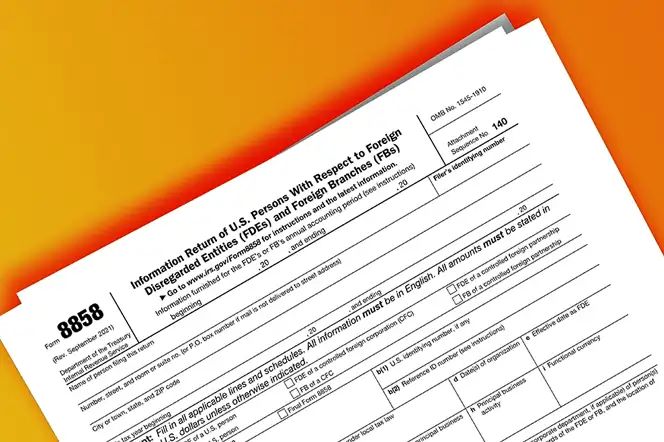
Form 8858: Foreign disregarded entity reporting
If you are a US expat running certain types of foreign businesses or overseas self-employment activity, there is a decent chance Form 8858 applies to you, even if nobody has mentioned it before.
Form 8858 is an IRS information return used to report foreign disregarded entities (FDEs) and foreign branches (FBs). Many Americans abroad discover the form after opening a UK Ltd company, operating through an Australian Pty Ltd, freelancing overseas, or setting up a one-owner foreign business.
Last updated May 22, 2026
Written by: Grace Lorraine Angeles
In this article
Quick answers about Form 8858
|
Question |
Short answer |
|
What is Form 8858? |
An IRS reporting form for foreign disregarded entities and foreign branches |
|
Who files Form 8858? |
Certain US persons with ownership or reporting obligations tied to foreign business activity |
|
Does Form 8858 create tax by itself? |
Usually no. It is primarily an information return |
|
Is Form 8858 common for expats? |
Common among expats with certain foreign companies or foreign branch activity |
|
What are the penalties? |
Penalties often begin at US$10,000 per form |
|
Is Form 8858 attached to a tax return? |
Yes, usually to Form 1040, 1120, or another return |
What is Form 8858?
Form 8858 is an IRS information return used to report foreign disregarded entities and foreign branches owned or operated by US taxpayers. The IRS uses the form to track:
- Foreign business income
- Ownership structures
- Foreign operations
- Transactions between related parties
- Overseas branch activity
The form is commonly attached to:
- Form 1040
- Form 1120
- Form 1065
- Form 5471
- Form 8865
It is not technically a tax calculation form in the same way as Form 1040 or Schedule SE. However, it can still become a major compliance issue if ignored.
The IRS updated the current Form 8858 instructions in December 2024, and those revisions remain in use for 2025 tax returns filed in 2026.
What is a foreign disregarded entity (FDE)?
A foreign disregarded entity (FDE) is a foreign business that the IRS does not treat as separate from its owner. Instead, the IRS usually treats the business income as belonging directly to the owner.
“Disregarded” simply means the IRS looks through the business and treats the income as the owner’s income directly.
For example, a foreign single-member business may legally exist under local law. However, the IRS may still treat the income as belonging directly to the US owner. That creates reporting obligations even if the country where the business operates treats the company as separate.
Common examples of foreign disregarded entities
|
Business structure |
Possible IRS treatment |
|
Foreign single-member company |
May be an FDE, depending on default classification or Form 8832 election |
|
Foreign LLC-type entity |
May be an FDE if disregarded from its owner under US entity classification rules |
|
Sole proprietorship abroad |
May be reported as foreign branch activity rather than an FDE |
|
Foreign corporation with multiple owners |
Usually not an FDE |
|
Foreign partnership |
Usually partnership reporting instead |
The IRS may classify foreign businesses differently depending on the country, ownership structure, and entity type. For example, a UK Ltd company may not receive the same IRS treatment as an Australian Pty Ltd or a French SARL.
That is where many expats accidentally fall into Form 8858 reporting.
Who must file Form 8858?
US citizens, Green Card holders, and some US business owners may need to file Form 8858 if they own a foreign disregarded entity or operate a foreign branch.
You may need to file Form 8858 if you:
- Own a foreign disregarded entity directly or indirectly
- Operate a foreign branch
- File certain other international forms connected to foreign entities
Common situations that may require Form 8858
- You may need Form 8858 if you own a foreign single-member company
This is one of the biggest Form 8858 triggers for US expats. Common examples can include single-owner foreign companies or LLC-type structures, but classification depends on the entity type, country rules, ownership, and whether any US entity classification election has been made.
A business can exist as a corporation under local law while still being treated as “disregarded” for US tax purposes. That distinction confuses many expats because local accountants often focus only on domestic rules. - You may need Form 8858 if you operate a foreign branch
Some expats run their business overseas directly instead of creating a separate company. They may operate through:- Direct sole proprietorship activity abroad
- Foreign branch operations
- Self-employment or freelance work overseas
Whether freelance or self-employment activity rises to foreign branch reporting can depend on whether the activity constitutes a foreign branch or foreign qualified business unit. In some situations, foreign branch reporting alone can trigger Form 8858 filing requirements.
- You may need Form 8858 if other international forms apply
Form 8858 may appear alongside Form 5471 or Form 8865. Form 8832 may also be relevant when an entity classification election is made.
Sometimes, only one or the other form applies, and occasionally multiple forms are required. This is where professional tax advice often becomes helpful because the IRS may classify the business differently than the local country does.
What is a foreign branch?
A foreign branch usually means a US person is running business activities overseas directly rather than through a separate corporation for US tax purposes.
Not every Form 8858 filing involves a company. Some US expats trigger Form 8858 through self-employment or direct overseas business activity instead.
Examples may include:
- Consulting abroad
- Remote freelancing
- Overseas contracting
- Digital services businesses
- Operating under a personal trade name overseas
Foreign branch reporting is now a more visible issue because Form 8858 specifically covers foreign branches as well as FDEs.
When Form 8858 applies and when it may not apply
|
Business structure or activity |
Possible IRS treatment |
Form 8858 likely? |
Other forms that may apply |
|
Personally owned foreign rental property |
Usually direct ownership |
Usually no |
Schedule E, FBAR, Form 8938 |
|
Foreign eligible entity with one owner |
May be treated as disregarded |
Possibly yes |
Form 8858 |
|
Foreign LLC-type entity |
Depends on IRS classification rules |
Possibly yes |
Form 8858 or Form 5471 |
|
Sole trader or sole proprietorship abroad |
May be treated as foreign branch activity |
Sometimes |
Form 8858 |
|
UK Ltd company |
Depends on classification and elections |
Possibly |
Form 5471 or Form 8858 |
|
Australian Pty Ltd company |
Often treated as foreign corporation |
Often no for Form 8858 specifically |
Form 5471 may apply |
|
Foreign partnership |
Partnership treatment |
Usually no for Form 8858 |
Form 8865 |
|
Foreign corporation with multiple owners |
Corporate treatment |
Usually no |
Form 5471 |
|
Foreign entity with Form 8832 election |
Depends on elected classification |
Depends |
Form 8858 or Form 5471 |
What information does Form 8858 report?
Form 8858 reports financial, ownership, and transactional information connected to foreign disregarded entities and foreign branches.
The form may require:
- Income statement information
- Balance sheet information
- Ownership details
- Foreign tax information
- Functional currency reporting
- Related-party transaction disclosures
How to file Form 8858?
Form 8858 is usually filed together with your regular US tax return. You generally do not mail it separately as a standalone form.
Step-by-step overview
- Determine the business structure
- Identify whether the entity is disregarded
- Gather foreign financial records
- Convert amounts into US dollars where required
- Complete the necessary schedules
- Attach Form 8858 to the tax return
- Review related international reporting forms
Where is Form 8858 filed?
Form 8858 is commonly attached to:
|
Taxpayer type |
Attached return |
|
Individual |
Form 1040 |
|
Corporation |
Form 1120 |
|
Partnership |
Form 1065 |
|
Trust or estate |
Form 1041 |
Form 8858 is often filed together with other international reporting forms required for Americans abroad, which include:
- FBAR
- Form 8938
- Form 5471
- Other foreign reporting forms.
That overlap is one reason international tax compliance can become complicated quickly.
When is Form 8858 due?
Form 8858 is generally due with the taxpayer’s annual US income tax return, including extensions. For the 2025 tax year filed in 2026, common filing deadlines for US expats include:
|
Deadline |
Meaning |
|
April 15, 2026 |
Standard US tax deadline |
|
June 15, 2026 |
Automatic extension for Americans abroad |
|
October 15, 2026 |
Additional extension if Form 4868 is filed |
Missing the form while filing the underlying tax return can still create penalties.
What if I never filed Form 8858?
If you never filed Form 8858, you may still be able to correct prior-year reporting through amended filings or IRS compliance procedures, depending on your situation.
This is extremely common among expats. Many people discover Form 8858 years later, after learning their foreign business created a US reporting obligation.
In some cases, taxpayers may need to file amended returns, submit delinquent international information returns, or use the IRS Streamlined Filing Compliance Procedures to correct past reporting issues.
Can Streamlined Filing help if I missed Form 8858?
Yes, some US expats who missed Form 8858 may qualify for the IRS Streamlined Filing Compliance Procedures if the failure was non-willful.
The Streamlined program is designed for taxpayers who failed to meet US international reporting obligations but did not intentionally avoid compliance.
In practice, Form 8858 problems are often connected to other missed filings, such as:
- FBARs
- Form 8938
- Form 5471
- Foreign income reporting issues
That is why fixing Form 8858 usually involves reviewing the entire international tax situation rather than correcting only one form.
Some taxpayers assume they should immediately use the IRS Streamlined Filing Compliance Procedures after discovering a missed form. However, the correct approach depends heavily on the facts, filing history, and overall risk profile.
What happens if I don’t file Form 8858?
Failure to file Form 8858 may trigger IRS penalties beginning at US$10,000 per form, even if the foreign business earned little income or no US tax was due.
Possible consequences of non-filing
|
Issue |
Possible consequence |
|
Failure to file |
US$10,000 starting penalty |
|
Continued noncompliance |
Additional penalties |
|
Missing international forms |
Extended IRS review periods |
|
Incomplete reporting |
Potential audit exposure |
In some situations, missing Form 8858 may also affect foreign tax credit claims, statute of limitations periods, and broader IRS reviews of foreign accounts and international reporting.
Do I need Form 8858 if I am self-employed abroad?
Possibly. Many self-employed Americans living overseas do not realize their business setup may create additional IRS reporting requirements.
Imagine an American living in Australia who works as a freelance graphic designer. They register locally as a sole trader because that is the standard setup in Australia. From the Australian side, everything may look straightforward.
However, the IRS may treat that business activity as a foreign branch. That can create Form 8858 filing obligations even though:
- There is no large company
- There are no employees
- The business is relatively small
That difference between local rules and IRS rules is where many expats get confused.
Most countries allow small business owners to use simple local business structures. The problem is that the IRS may not treat the business the same way the foreign country does.
That is one reason many digital nomads, consultants, remote workers, and freelancers end up dealing with Form 8858 unexpectedly.
Frequently Asked Questions
-
Does filing Form 8858 mean I owe more US tax?
Not automatically. Form 8858 is primarily an information return. Filing it does not necessarily increase your US tax bill. However, the foreign business income connected to the form may still affect:
- Self-employment tax
- Foreign tax credits
- Foreign Earned Income Exclusion calculations
- Other international reporting obligations
Many expats are surprised to learn that the reporting requirement itself exists even when little or no US tax is ultimately due.
-
Is Form 8858 filed separately?
-
Can I have Form 8858 and Form 5471 at the same time?
-
Does Form 8858 apply only to incorporated businesses?
-
What if my foreign business already pays tax overseas?
Prefer to talk it through? Schedule your free callback today.


Grace Lorraine, an IRS Enrolled Agent and CPA with 15 years of expat tax experience, specializes in US tax preparation, tax planning, and tax advice for US citizens and Green Card holders living and working in the Middle East. Grace is also an expert in handling Streamlined Filing Compliance Procedure cases.