What is Form 8867?
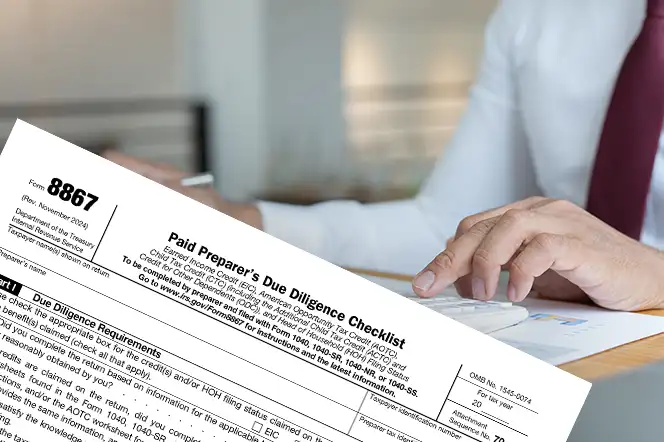
Form 8867, officially called the Paid Preparer’s Due Diligence Checklist, is a form that paid tax preparers complete when claiming certain tax credits or filing statuses for a taxpayer.
Many Americans abroad first encounter Form 8867 when their tax preparer asks for additional information to support a tax credit or filing status. While the tax preparer completes the form, you may still need to provide the necessary documents or information.
Understanding why the form exists can help you respond more confidently when your preparer asks for supporting documents.
Last updated June 30, 2026
Written by: Grace Lorraine Angeles
In this article
Which tax credits trigger Form 8867?
Form 8867 is required when a paid tax preparer claims certain tax credits or the Head of Household filing status on behalf of a taxpayer.
The following table shows the tax credits and filing status that require Form 8867.
Tax credits and filing statuses that require Form 8867
|
Tax Benefit |
Form 8867 required? |
|
Yes |
|
|
Yes |
|
|
Yes |
|
|
Yes |
|
|
Yes |
|
|
Yes |
Naturally, many taxpayers wonder whether Form 8867 can affect their refund.
Can Form 8867 affect my tax refund?
Form 8867 does not affect your refund by itself, but it can affect whether certain tax credits are claimed on your return.
If a tax preparer cannot verify your eligibility for a credit covered by Form 8867, including the Child Tax Credit, Additional Child Tax Credit, Credit for Other Dependents, Earned Income Tax Credit, or American Opportunity Tax Credit, the credit may not be claimed until sufficient documentation is provided.
Providing complete and accurate information can help ensure eligible credits are included on your return and help avoid unnecessary delays, because Form 8867 is connected to several popular tax credits, many taxpayers assume they must file it themselves. In most cases, that is not the case.
Do I need to file Form 8867?
Usually, no. Form 8867 is completed by a paid tax preparer, not by the taxpayer.
If you hire a CPA, Enrolled Agent, or other tax professional, they are responsible for completing the form when it applies. Your role is generally limited to providing any information or documents needed to support the credits or filing status being claimed.
In some situations, taxpayers may see Form 8867 attached to a return, but the responsibility for completing it belongs to the preparer.
Common situations where Form 8867 may apply:
- Child Tax Credit (CTC). A preparer may request birth certificates, Social Security information, or school records to verify that a child meets the IRS requirements for the credit.
- Head of Household status. A preparer may ask for information about household members, living arrangements, or financial support to confirm that you qualify for this filing status.
- American Opportunity Tax Credit (AOTC). A preparer may request college enrollment records or tuition statements to verify eligibility for the education credit.
What documents might my tax preparer request?
The documents requested depend on the tax benefit being claimed and your specific circumstances.
Common examples include:
- Birth certificates. These may be used to verify a child’s identity, age, and relationship to the taxpayer.
- School enrollment records. School records can help support dependent-related claims and may provide evidence of where a child lives.
- Social Security cards. A preparer may request Social Security information to confirm that the taxpayer and any qualifying children meet the applicable identification requirements.
- Custody agreements. These documents may help determine which parent is entitled to claim a child when parents are divorced, separated, or share custody.
- Adoption records. Adoption paperwork may be needed to establish a legal relationship between the taxpayer and the child being claimed.
- Proof of residency. Documents such as school records, government correspondence, or other official records may help support residency-related requirements.
- College or education records. If the American Opportunity Tax Credit is being claimed, your preparer may request Form 1098-T and other documents that verify enrollment and qualified education expenses.
Note: Foreign-issued documents may be accepted, although a tax preparer may request an English translation or additional supporting evidence.
For the American Opportunity Tax Credit, foreign education records alone may not be enough, as the student and educational institution must also meet the IRS eligibility requirements.
What happens if information is missing or incorrect?
Missing or incorrect information can delay refunds, trigger additional documentation requests, or prevent certain tax credits from being claimed.
Possible consequences include:
- Requests for additional documentation
- Delayed refunds
- Additional IRS correspondence
- Reduced tax credits
- Disallowed tax credits
For this reason, it is generally easier to provide complete information during the preparation process rather than responding to questions after the return has been filed. If a preparer cannot verify eligibility for a credit, they may choose not to claim it until sufficient documentation is provided.
What is the difference between Form 8867 and Form 8862?
Although the form numbers are similar, Form 8867 and Form 8862 serve different purposes.
Form 8867 vs Form 8862
|
Form |
Who completes it? |
Purpose |
|
Form 8867 |
Paid tax preparer |
Documents the preparer’s compliance with IRS due diligence requirements when claiming certain tax credits or filing statuses. |
|
Taxpayer |
Allows a taxpayer to reclaim the EITC, CTC, ACTC, ODC, or AOTC after the IRS previously reduced or disallowed the credit for a reason other than a math or clerical error. |
In simple terms, Form 8867 relates to a preparer’s responsibilities, while Form 8862 relates to a taxpayer’s ability to reclaim certain tax benefits.
Frequently Asked Questions
Does Form 8867 affect how long it takes to get my tax refund?
Not directly. However, if additional documentation is needed before a return can be filed, the preparation process may take longer. Missing information can also delay the review of certain tax credits.
Can Form 8867 apply if I use tax software instead of a tax preparer?
Generally, no. Form 8867 applies to paid tax preparers, not taxpayers who prepare their own returns using tax software. However, if the software includes a paid preparer who prepares or signs your return, Form 8867 may still apply.
Can foreign-language documents be used to support a tax credit claim?
Often, yes. Documents issued outside the United States may still be accepted. A tax preparer may request an English translation or additional supporting records.
Is Form 8867 required every year?
If a paid preparer claims a tax credit or filing status covered by Form 8867, the checklist generally must be completed for that tax year, even if the same benefit was claimed in prior years.
What should I do if I cannot find the documents my preparer requested?
Tell your preparer as soon as possible. Alternative records may sometimes be available, depending on the information that needs to be verified.
Does Form 8867 apply to taxpayers without children?
Yes. While Form 8867 is commonly associated with child-related tax credits, it may also apply when a paid tax preparer claims the Earned Income Tax Credit (EITC), the American Opportunity Tax Credit (AOTC), or the Head of Household filing status on behalf of a taxpayer.
Is Form 8867 the same as Form 8863?
No. Form 8867 is completed by a paid tax preparer to document due diligence, while Form 8863 is used to claim education credits. If the American Opportunity Tax Credit is claimed, both forms may be included with the return.
Prefer to talk it through? Schedule your free callback today.


Grace Lorraine, an IRS Enrolled Agent and CPA with 15 years of expat tax experience, specializes in US tax preparation, tax planning, and tax advice for US citizens and Green Card holders living and working in the Middle East. Grace is also an expert in handling Streamlined Filing Compliance Procedure cases.