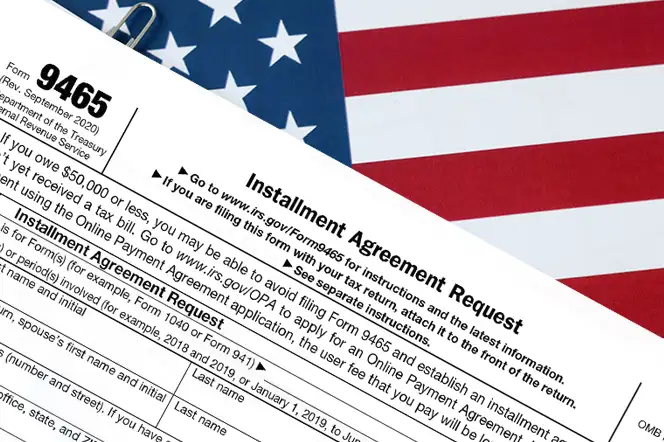
What is IRS Tax Form 9465?
IRS Tax Form 9465, officially called the Installment Agreement Request, is the form taxpayers use to request a monthly payment plan when they cannot pay their tax bill in full. If approved, the IRS allows you to pay your balance over time instead of making one large payment.
Owing money to the IRS can be stressful, especially for Americans abroad. If you cannot pay your tax bill in full, Form 9465 allows you to request a monthly payment plan and pay your balance over time.
If you’ve been wondering what IRS Tax Form 9465 is and how it works, this guide explains the basics in plain English.
Last updated June 29, 2026
Written by: Grace Lorraine Angeles
In this article
How does Form 9465 work?
Form 9465 allows taxpayers to request an installment agreement to pay an IRS tax balance over time. Instead of paying your entire balance immediately, you propose a monthly payment amount.
To better understand how Form 9465 fits into the IRS payment plan process, the table below highlights the important facts.
Form 9465 at a glance
|
Question |
Answer |
|
What is Form 9465? |
Installment Agreement Request |
|
What is it used for? |
Requesting a monthly IRS payment plan |
|
Who uses it? |
Taxpayers who cannot pay their balance in full |
|
Can Americans abroad use it? |
Generally yes |
|
Does the IRS automatically approve it? |
No |
In some situations, taxpayers who owe US$10,000 or less in tax (excluding penalties and interest) may qualify for a guaranteed installment agreement if they meet certain IRS requirements, including a history of filing and paying taxes on time and the ability to pay the balance within three years.
Taxpayers with total balances of US$50,000 or less, including tax, penalties, and interest, may also qualify to apply online through the IRS Online Payment Agreement system, provided all required tax returns have been filed.
If the request is approved, monthly payments continue until the balance is paid in full. The following example shows how Form 9465 may work in practice.
Example
One of our clients living in Germany discovered they owed approximately US$4,500 after catching up on several years of US tax filings. Because paying the balance in full was difficult, they applied for an IRS installment agreement to spread the payments over time.
Who qualifies for Form 9465?
Taxpayers who owe federal taxes and cannot pay their balance in full may qualify to request an IRS installment agreement using Form 9465. This includes Americans living overseas.
The IRS also expects taxpayers to file required tax returns and remain compliant with future tax obligations.
Important: Living overseas does not remove your US tax obligations. If you owe tax, addressing the balance early can help prevent additional interest, penalties, and collection notices.
Step-by-step: How do you file Form 9465?
You can file Form 9465 by completing it and submitting it to the IRS with your tax return, or separately after receiving a balance due notice. Some taxpayers may also qualify to apply online through the IRS Online Payment Agreement system.
Applying online may be faster, can have lower setup fees than applying by phone, mail, or in person, and qualifying taxpayers may receive immediate notification of approval.
Step 1: Gather your information. Before completing Form 9465, gather your personal information, Social Security number, tax balance, proposed monthly payment amount, and banking information if you plan to use direct debit.
Step 2: Complete Form 9465. Enter your personal information, the amount you owe, and the monthly payment you can reasonably afford. Choosing a realistic payment amount can help you stay current with the agreement if it is approved.
Step 3: Submit your request. Form 9465 can generally be submitted with your tax return or mailed after you receive a balance due notice. If you qualify to apply online, you may be able to use the IRS Online Payment Agreement application instead of mailing Form 9465.
Filing Tip: If you are mailing Form 9465, use the mailing address listed in the latest IRS instructions, as the correct address can vary depending on where you file.
How much does Form 9465 cost in 2026?
There is no fee to submit Form 9465 itself, but the IRS may charge a setup fee if your installment agreement is approved. The amount depends on the payment method you choose and how you apply.
IRS installment agreement setup fees for 2026
|
Payment Plan type |
Online application |
Phone, Mail, or In-Person |
|
Direct debit installment agreement |
US$22 |
US$107 |
|
Non-direct debit installment agreement |
US$69 |
US$178 |
Direct debit installment agreements generally have lower setup fees because payments are automatically withdrawn from your bank account each month.
Note: Reduced or waived fees may be available for qualifying low-income taxpayers. IRS fees can change, so always check the latest IRS guidance before applying.
What happens after I submit Form 9465?
After you submit Form 9465, the IRS reviews your request and determines whether to approve the payment arrangement.
In many cases, the IRS sends a written response explaining whether the request has been approved or whether additional information is needed.
Taxpayers often have questions about processing times, approval, and what happens next after they submit the form. The answers below address some of the most common concerns.
- How long does it take to process Form 9465?
Processing times vary, but taxpayers should generally allow several weeks for the IRS to review a payment plan request. However, qualifying taxpayers who apply through the IRS Online Payment Agreement system may receive an immediate approval decision. - Does being processed mean approved?
No. A request that is being processed has not necessarily been approved. It simply means the IRS is reviewing the information provided. - Does Form 9465 stop penalties and interest?
No. Interest and some penalties generally continue to accrue until the balance is paid in full, even if the IRS approves your installment agreement. However, an installment agreement can help you avoid more serious IRS collection actions. - Can the IRS reject Form 9465?
Yes. The IRS may reject a request if the taxpayer does not meet the requirements or provides incomplete information. Common reasons include unfiled tax returns or a proposed payment amount the IRS considers insufficient. Taxpayers may have appeal rights if a request is rejected or an agreement is terminated.
Form 9465 vs Online Payment Agreement: Which should I use?
Form 9465 is the IRS’s formal Installment Agreement Request form, while the Online Payment Agreement is the IRS’s online application for requesting a payment plan.
Both methods can be used to request an installment agreement, although eligibility for the online system depends on the taxpayer’s circumstances.
Form 9465 vs IRS Online Payment Agreement
|
Feature |
Form 9465 |
Online Payment Agreement |
|
Application method |
Installment Agreement Request form |
Online application |
|
Submission |
By mail, with a tax return, or through certain electronic filing methods |
IRS website |
|
Processing |
May take longer |
Often faster |
|
Convenience |
More manual |
More convenient |
|
Setup fees |
Generally higher |
Generally lower |
|
Eligibility |
Broad |
Subject to IRS eligibility requirements |
Frequently Asked Questions
What happens if I don’t request a payment plan?
If you do not pay your tax balance or arrange a payment solution, the IRS may continue charging interest and penalties. In some cases, the IRS may also begin collection actions to recover the debt.
How do I choose a monthly payment amount?
Choose a payment amount you can realistically afford each month. Missing payments can put your installment agreement at risk. If your proposed amount is too low, the IRS may require a higher payment or additional financial information.
What happens if I miss a payment?
Missing a payment may cause your installment agreement to default. If that happens, the IRS may resume collection efforts and require you to make new payment arrangements.
What is the difference between Form 433-D and Form 9465?
Form 9465 is used to request an installment agreement. Form 433-D, Installment Agreement, is often used after the IRS approves a payment plan and outlines the terms of the agreement.
Can I pay off my IRS payment plan early?
Yes. You can generally pay off your tax balance at any time. Paying early may reduce the interest and penalties that accrue on the unpaid balance.
Can I change my monthly payment amount?
Possibly. The IRS may allow changes to an existing installment agreement, although additional review may be required. Eligible taxpayers may also be able to use the IRS Online Payment Agreement tool to request changes, including updates to payment amounts, payment dates, or direct debit information.
Do I have to pay a fee to set up an installment agreement?
In many cases, yes. The IRS may charge a setup fee, which varies by payment plan and application method. Online applications often have lower fees, and reduced fees may be available for qualifying low-income taxpayers.
Prefer to talk it through? Schedule your free callback today.


Grace Lorraine, an IRS Enrolled Agent and CPA with 15 years of expat tax experience, specializes in US tax preparation, tax planning, and tax advice for US citizens and Green Card holders living and working in the Middle East. Grace is also an expert in handling Streamlined Filing Compliance Procedure cases.