What is a W-8 Form?
A W-8 Form is a series of IRS forms used by non-US individuals and foreign entities to certify their foreign status and, in some cases, claim reduced US withholding tax rates under an income tax treaty.
If you receive US-source income while living outside the US, there is a good chance you will encounter a W-8 Form at some point. Banks, brokers, investment platforms, online marketplaces, and US businesses frequently request these forms before making payments to foreign individuals or organizations.
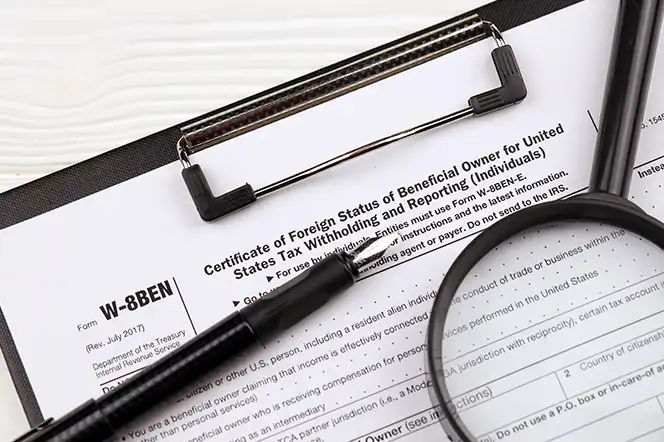
Many people assume that there is a single IRS document called the “W-8 Form.” In reality, the term refers to a group of related forms designed for different situations. The most common version is Form W-8BEN, which foreign individuals use to certify their non-US status and potentially reduce US withholding taxes through tax treaty benefits.
Understanding which W-8 Form applies to you can help prevent unnecessary withholding, payment delays, and compliance issues.
Last updated June 18, 2026
Written by: Jeff Patterson
In this article
Why would I need a W-8 Form?
You may need a W-8 Form if you are not a US person and receive certain types of US-source income. The IRS requires US payers to verify whether the recipient of income is a US person or a foreign person. Without proper documentation, the payer may be required to withhold tax at the highest applicable rate.
Common situations where a W-8 Form may be requested include:
- Receiving dividends from US stocks
- Earning interest from US financial institutions
- Working as an independent contractor for a US company (depending on where the work is performed)
- Selling products through US-based marketplaces
- Receiving royalty income
- Monetizing YouTube, TikTok content, or other digital platforms
- Investing through a US brokerage account
- Receiving partnership or trust distributions with US tax implications
In practice, many people first learn about W-8 Forms when opening an investment account or receiving a compliance request from a financial institution.
Is there an IRS Form W-8?
Not exactly. There is no single active IRS form simply called “Form W-8.” Instead, the IRS uses several W-8 forms that serve different purposes. Collectively, these documents are often referred to as the W-8 series.
Many banks and financial institutions still use the phrase “W-8 Form” in their communications because it is easier for customers to recognize. However, they are usually referring to one of the specific forms within the W-8 series.
This distinction matters because selecting the wrong form can result in incorrect withholding treatment or rejected documentation.
What are the different types of W-8 Forms?
The IRS currently uses several W-8 forms for different categories of foreign individuals and entities.
Table 1. Types of W-8 Forms
|
Form |
Who uses it |
Primary purpose |
|
Foreign individuals |
Certify foreign status and claim treaty benefits |
|
|
Foreign entities |
Certify foreign entity status |
|
|
Individuals or entities with effectively connected income |
Certify income connected with a US trade or business |
|
|
Foreign governments and exempt organizations |
Claim exemption from withholding |
|
|
Intermediaries and flow-through entities |
Pass withholding information to payers |
Which W-8 Form do I need?
The correct W-8 Form depends on whether you are an individual or an entity and the type of US-source income you receive. While the IRS offers several W-8 forms for different situations, most foreign individuals will use Form W-8BEN. The table below shows some common scenarios and the W-8 form that is typically used.
Table 2. Examples of when a W-8 Form may be required
|
Situation |
Common Form |
|
Foreign investor holding US stocks |
W-8BEN |
|
Non-US freelancer working outside the US with a US company |
W-8BEN |
|
Foreign corporation receiving US-source income |
W-8BEN-E |
|
Foreign government or exempt organization |
W-8EXP |
|
Foreign intermediary handling payments |
W-8IMY |
What is Form W-8BEN and how does it work?
Form W-8BEN is used by foreign individuals to certify that they are not US persons and, when applicable, claim tax treaty benefits. This is the most widely used form in the W-8 family.
By submitting Form W-8BEN to the payer, you generally confirm:
- You are not a US citizen
- You are not a US resident alien
- You are the beneficial owner of the income
- You may qualify for treaty benefits under an applicable tax treaty
Without a valid W-8BEN on file, a US payer may be required to withhold tax at a higher rate than necessary.
Can a US citizen use Form W-8BEN?
No. US citizens should not use Form W-8BEN. US citizens and other US persons generally provide Form W-9 instead. Submitting a W-8BEN when you are actually a US person can create compliance issues and may result in incorrect reporting.
Can I claim tax treaty benefits using Form W-8BEN?
Yes, if your country has an income tax treaty with the US and you meet the applicable requirements. Tax treaties can reduce or eliminate withholding tax on certain categories of income, including:
- Dividends
- Interest
- Royalties
- Certain compensation arrangements
However, treaty benefits vary significantly from one treaty to another. The available rate depends on both the country involved and the type of income being received. Additionally, for personal-service compensation, Form 8233 may be required instead.
One common misconception is that every foreign individual automatically qualifies for treaty benefits. That is not always the case. Eligibility depends on the specific treaty provisions and your circumstances.
How do I fill out Form W-8BEN?
Completing Form W-8BEN is generally straightforward if you have the necessary information available.
Step 1: Enter your identifying information
Complete the personal information section using details that match your official records. You will generally need to provide:
- Full legal name
- Country of citizenship
- Country of permanent residence
- Permanent residence address (your primary residential address, not a PO box)
- Mailing address (if different from your permanent residence address)
Step 2: Provide tax identification information
Enter any tax identification numbers required for your circumstances. Depending on your situation, this may include:
- Foreign Tax Identification Number (FTIN)
- US Taxpayer Identification Number (TIN), such as a Social Security Number (SSN) or Individual Taxpayer Identification Number (ITIN), if applicable
- Date of birth, where required on the form or by the institution collecting it.
Step 3: Claim treaty benefits if eligible
If your country has an income tax treaty with the United States and you qualify for reduced withholding, complete the treaty benefits section. You may need to:
- Identify your country of tax residence
- Specify the treaty article that applies
- State the reduced withholding rate being claimed
- Confirm that you meet the treaty’s eligibility requirements
Step 4: Sign and certify the form
Carefully review all information before signing. By signing the form, you certify under penalties of perjury that the information provided is accurate and that you are the beneficial owner of the income (or otherwise authorized to sign).
Most financial institutions now allow electronic submission, although procedures vary.
How long is a W-8 Form valid?
Many W-8 Forms, including Form W-8BEN in common situations, generally remain valid through the end of the third calendar year following the year in which the form was signed, unless a change in circumstances occurs.
For example:
|
Date Signed |
Typical Expiration |
|
June 2026 |
December 31, 2029 |
|
September 2026 |
December 31, 2029 |
A new form may be required sooner if your circumstances change. Examples include:
- Change of residency
- Change in entity classification
- Loss of treaty eligibility
- Changes affecting beneficial ownership
Many financial institutions will request an updated form before the expiration date.
Is a W-8 Form the same as a W-9 Form?
No. A W-8 Form and a W-9 Form serve different purposes. The distinction comes down to whether the recipient is a foreign person or a US person.
Table 3. W-8 Form vs W-9 Form
|
Feature |
W-8BEN |
W-9 |
|
Used By |
Foreign individuals |
US persons |
|
Purpose |
Certify foreign status |
Provide taxpayer information |
|
Tax Treaty Benefits |
Possible |
Not applicable |
|
Typical Recipient |
Non-US person |
US citizen, resident alien, or US entity |
If you are a US citizen, Green Card holder, or otherwise considered a US person for tax purposes, Form W-9 is generally the appropriate form.
What happens if I do not submit a W-8 Form?
Failure to provide a required W-8 Form can lead to higher withholding taxes and payment delays. In many cases, a payer that lacks valid documentation must apply withholding based on default rules rather than treaty-reduced rates.
Potential consequences include:
- Excess withholding tax
- Delayed payments
- Account restrictions
- Additional compliance reviews
While refunds may sometimes be available through tax filings, it is usually easier to provide accurate documentation from the beginning.
What happens if I use the wrong W-8 Form?
Using the wrong W-8 Form can create withholding and reporting problems. Common issues include:
- Incorrect tax withholding
- Rejected documentation
- Requests for corrected forms
- Delays in processing payments
The good news is that these problems are often fixable once the correct form is submitted. However, correcting withholding issues after the fact can be more complicated than getting the documentation right initially.
For that reason, individuals receiving US-source income should verify which W-8 Form applies to their situation before completing the form.
If your circumstances involve complex treaty claims, foreign business structures, or substantial US investments, professional guidance may help ensure that the correct documentation is being used.
Frequently Asked Questions
Do I send Form W-8BEN to the IRS?
No. Form W-8BEN is generally provided directly to the bank, brokerage firm, financial institution, or payer requesting it. Most individuals do not submit Form W-8BEN directly to the IRS.
Can I complete Form W-8BEN online?
Often, yes. Many banks, investment platforms, and financial institutions allow electronic completion and submission of Form W-8BEN. The process varies by institution, so you should follow the instructions provided by the organization requesting the form.
Can a foreign freelancer use Form W-8BEN?
In many cases, yes. A non-US freelancer working with a US company may be asked to provide Form W-8BEN to certify their foreign status. However, the appropriate form can depend on the nature of the work and whether the income is connected with a US trade or business.
If the freelancer is claiming a treaty exemption for personal-service income, Form 8233 may be required instead.
Can I update a W-8 Form before it expires?
Yes. If your circumstances change, such as your country of residence, citizenship, entity classification, or treaty eligibility, you should provide an updated form rather than waiting for the current form to expire.
Does a W-8 Form eliminate US tax completely?
Not necessarily. A W-8 Form does not automatically eliminate US tax. Instead, it helps determine the correct withholding treatment. Depending on the type of income and any applicable tax treaty, withholding may be reduced, eliminated, or remain unchanged.
Can I have more than one W-8 Form on file?
Sometimes. Individuals and businesses with multiple financial accounts or income sources may submit separate W-8 Forms to different institutions. Each payer generally maintains its own documentation requirements.
What should I do if a bank or brokerage rejects my W-8 Form?
Start by reviewing the rejection notice carefully. Common reasons include missing information, incorrect treaty claims, incomplete signatures, or the use of the wrong W-8 Form. Correcting the issue and resubmitting the form is often enough to resolve the problem.
Do cryptocurrency exchanges or online investment platforms require a W-8 Form?
Some do. International users of investment platforms, brokerages, and certain cryptocurrency-related services may be asked to complete a W-8 Form before receiving US-source income. Requirements vary between platforms and jurisdictions.
Prefer to talk it through? Schedule your free callback today.


Jeff Patterson is an American living in Scotland and joined the team at Expat Tax Online after experiencing the complexities of living abroad with a family.
As a Client Services Manager, Jeff assists Americans living abroad in identifying and accessing the tax solutions best suited to their unique circumstances.